
A Charitable Response to Pints with Aquinas on the SSPX
Where Matt Fradd and Jacob Phillips went right and wrong

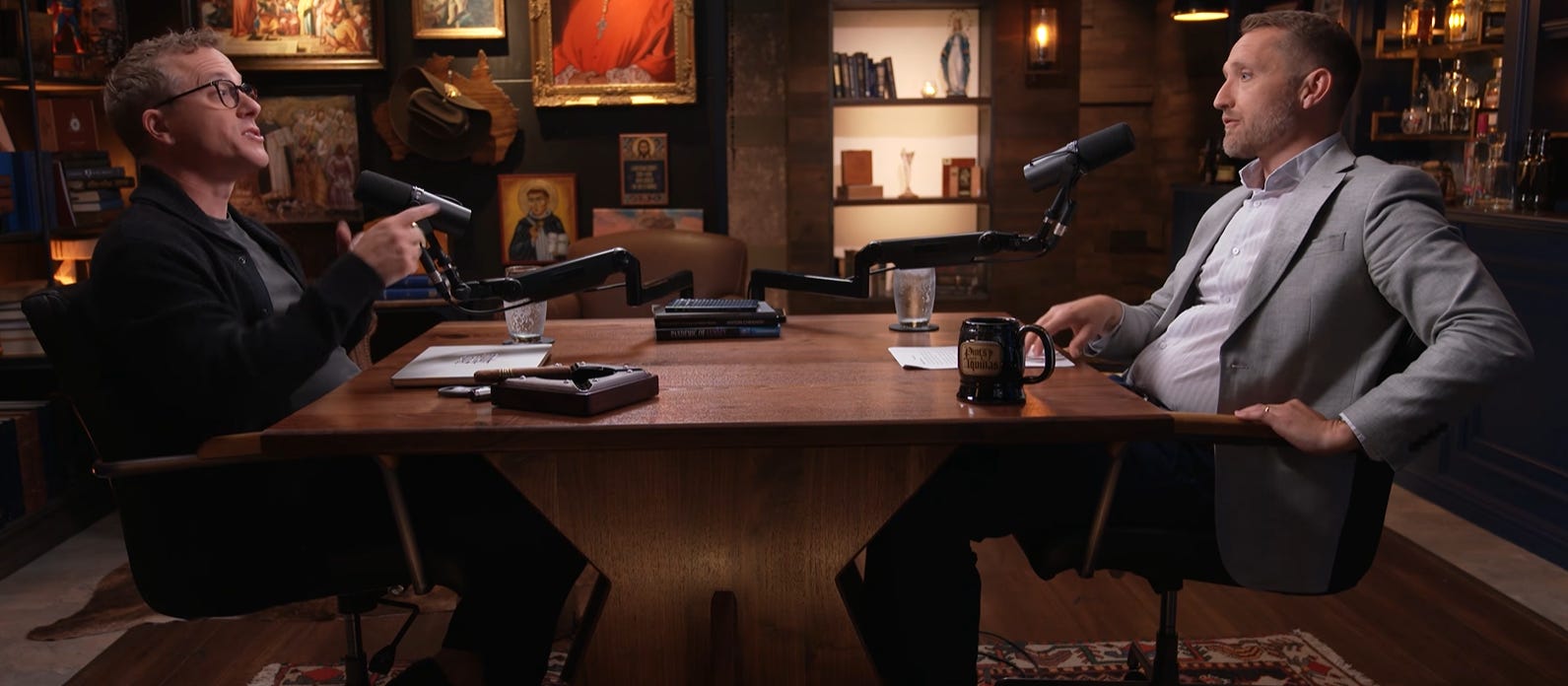
On July 1st, the Society of St. Pius X (SSPX) will almost certainly, barring some last-minute intervention, consecrate four bishops against the will of the Pope. This has sparked and will inevitably spark a myriad of opinions, responses and hot takes for the Catholic media landscape. Today I spent the time to go through one such reaction with the latest episode of Pints with Aquinas with Matt Fradd and his guest Jacob Phillips. I would caution anyone who is tempted to view this interview in a polemical way, or to respond to it as such as both men dealt with these issues in an intelligent manner and deserve an intelligent consideration. Matt Fradd deserves a lot of credit for shaping his interviews in a way that gets to deeper themes by forcing his guests to attack steelman objections. This provided for a great deal of reflection and understanding that I think was positive, particularly in the realm of how to stay sane when it seems like the entire world and even the Church seems to have lost its wits. However, there are a number of points and solutions embedded into the narrative that Phillips and Fradd presented that I think are insufficient to understand the position of traditionalist Catholics today, particularly those who not only sympathize with but actively find fellowship and solace in communities serviced by priests of the SSPX.
I think I have a unique background to provide some insight into the minds of those who are firmly in the SSPX camp. I converted to Catholicism during the Francis Pontificate through a typical parish which only celebrated the Novus Ordo, was unjustly prevented from receiving valid sacraments from the Church for nearly a year and afterwards found the SSPX. I went on to be academically formed by them at their college in St. Mary’s Kansas, and have worked at, supported and promoted ministries and chapels run by the SSPX for over 6 years now, while at the same time maintaining friendships and good relationships with Byzantine, diocesan and “indult” Catholic brothers, sisters and communities. What I have learned over my time as a Catholic is that there seems to be a complete lack of understanding and appreciation of the position that traditional Catholics hold, and I hope that through this article and further conversation, we all can move towards a greater respect for the positions being put forward.
The Privatization of the Crisis
One of the early cruxes of the interview was illustrated by Phillips when he said that decisions involving conscience are only pertinent when one is required to act. As an example of this point, Fradd and Phillips used the change in the Catechism regarding the death penalty. In such a matter, the two suggested that it might be better for one to look at one’s state in life and unless one had to, for example, execute a man himself, perhaps it is best if we all simply ignored the issue and put our heads down completely. I believe that this statement misses the mark in a few ways.
The first is the fact that Catholic teaching ought to spur and guide Catholic action. One of the principal Catholic arguments against Enlightenment thought is the fact that man is social by nature, he does not exist as a sole individual. Furthermore, “men living together in society are under the power of God no less than individuals are, and society, no less than individuals, owes gratitude to God who gave it being and maintains it and whose ever-bounteous goodness enriches it with countless blessings.” (Immortale Dei 6) If a magisterial contradiction regarding a fundamental point of political order appears on the level of a non-infallible statement, to say that Catholics ought to say nothing at all renders Catholic action sterile. If we use the present example, the death penalty, Catholics ought to either do what most dioceses encourage which is to militantly seek the abolition of the death penalty even in the case of pedophile cannibals, or seek to follow previous teaching. To do nothing risks either allowing serious injustice or the spread of an immoral institution. To simply do nothing is the kind of unstable middle position that St. John Henry Newman, in abandoning his own Via Media, taught us cannot hold. I might also add, that such an argument would similarly apply to the case of abortion. If Catholics should only make decisions involving conscience when we are required to act, this would imply that a Catholic ought not intervene in pro-life politics unless he himself were to be forced to murder a baby in the womb himself! If a pro-choice change were to happen in the Catechism, must Catholics sterilize their pro-life politics as well?
A second issue is the fact that this comes dangerously close to the anti-intellectual tick that is present in many Eastern circles, which is to blame the West for intellectualizing everything, and to claim that the only true path is to focus exclusively on the interior life. This fundamental impetus comes out in this interview quite often, saying that we are wasting our time with all of this, and ought to just pray and focus on what is in front of us. I believe that this impetus is wrong for the same reason that the Eastern tick is wrong, which is that every aspect of the faith and the liturgy ought to be pertinent to our salvation. Focusing and debating the Filioque, the Papacy or the legitimacy of the Latin Rite’s traditions are just as legitimate as debating whether or not the death penalty is legitimate, whether communion on the hand ought to be done, or whether or not lay people should be able to deliver homilies. We ought to have more respect for the Church and insist that she gives us doctrinal clarity not superfluously but for the sake of our souls.
A final concern I have with this attitude is the fact that it runs contrary to both the spirit and letter of the post-conciliar Church’s will on these matters. In terms of the Church’s post-conciliar will, the New Evangelization and the modern concept of synodality is constantly appealing for laymen and women to get involved in understanding and enacting the Church’s teachings. Phillips even points out during the interview that the post-conciliar magisterium has deemed it to be prudential to speak to modern man in a pastoral way, so that laypeople can read magisterial documents and interpret these documents themselves. To say that this lay participation in the life of the Church only extends to those who raise questions from the “left-wing” of the Church, or only when documents are to be interpreted in a vague, uncontroversial manner is to expose this project of lay literacy as being vapid and insincere. Something that was pointed out frequently at last year’s Roman Forum conference at Lake Garda is the fact that the “Spirit of Vatican II” is ironically being fulfilled in the best way by the traditionalist movement through its vigorous comparing, criticizing, synthesizing, and reckoning with pre and post conciliar texts. Lay people within the traditionalist community are engaging with Papal documents on a scale and in a way that has never been seen in the Church. Rather than seeing this as a weakness or a cause for scandal to be avoided, I see this as something to be encouraged.

In terms of the letter of the post-conciliar period, Phillips mentioned briefly the document Donum Veritatis which deals with the role of the theologian in times where dissent might be given to the Magisterium. What is often assumed here when dealing with traditionalists is that the traditionalist is in the position of dissenting from a magisterial document either by appealing to a lesser-weighted magisterial document or from his own private judgement (e.g. “I dissent from this teaching because of my interpretation of the Bible, or because St. Thomas said the opposite), what is often never appraised, even sufficiently by Donum Veritatis, is what is to occur when a newer and lesser-weighted magisterial pronouncement contradicts an older, perennial and higher-weighted magisterial pronouncement. The latter is almost exclusively the concern of the traditionalist (e.g. “I dissent from this teaching because earlier teaching infallibly taught the opposite) You find that this seems to be implicitly understood by Matt when he is surprised at Phillips asserting that the SSPX is “Protestant”, as it would be difficult to suggest that what the SSPX believes regarding the controversial issues in question (Religious Liberty, Ecumenism, Collegiality, the Liturgy, etc) would be condemned by pre-conciliar authority. What we are dealing with is not a dissension from the magisterium of the kind that we saw in 1968 from Charles Curran who dissented from Humanae Vitae or the modern liberal dissent from Church teaching on abortion, we are dealing with something else entirely. Phillips brought up the point that once you start saying that something in the Church ceases to be Catholic, you cease to be Catholic and that this is the error of the SSPX. But what about those in the Conciliar period who said that the pre-conciliar teaching itself wasn’t Catholic and that their new vision of the Church ought to be implemented? The same condemnation would fall on them at the time. If we say that at one moment the person accusing the Church could be the one that is a non-Catholic under the boot of the Church’s teaching and in the next moment be vindicated as the only true position, we are setting a dangerous precedent that goes beyond Catholic teaching regarding the development of doctrine and moving into the re-creation of dogma.
Reductio ad validitatem
There are very few issues within trad-conservative discussions that frustrate me. When I look at the discussions surrounding interpretations of the Second Vatican Council documents, or the nature of a schismatic act, or scholarly considerations of the liturgy, I can see multiple sides of the debate. One of the few issues that does frustrate me is the equivocation of the liturgical discussion on the grounds of validity. On this matter I find few people are actually consistent in adopting this perspective, and the faithful are chained to a position where they are forced to be scandalized. This is frequently done in Fradd’s interview with Phillips by saying that there is no justification for the Society’s actions or even the critiques of the traditionalist because at least your local parish’s mass is valid, even if there are guitars, irreverence or scandals. Phillips and Fradd take on the assertion of Father Pagliarani who states that “In an average parish, the faithful no longer find the necessary resources to ensure their eternal salvation.” The retort here, interestingly enough, is not to say that the average Novus Ordo isn’t terrible, but to say that the only thing that is sufficient is the validity of the Mass.
Something that is often conceded by traditionalists is that validity isn’t an issue with the Novus Ordo, that we are dealing with the fittingness of the liturgical ritual only. This isn’t true. And even Fradd points out that this is an issue in his testimony on why he went to the SSPX in Vienna, which was because the local parish was known for having an invalid mass with made-up words of consecration. I can also speak from experience that I have personally seen masses where the matter and form were doubtful, been to confessions where the priest refuses to say the proper words of absolution, have known and spoken to many people who have received invalid baptisms from priests, and was invalidly received into the Church at first myself. I have experienced none of these things within SSPX or other Latin Mass communities, but experienced them frequently within communities that celebrate the Novus Ordo. To call this merely a scandal, or that it is unacceptable is a tremendous understatement. The validity of the sacraments is merely the bare minimum for Catholics and in my experience and the experience of many, it is not something safely found in the average parish or at the very least is at risk in the average parish.
With this very important preface out of the way, we can go on to the main point which is to say that validity is not enough. If it were enough, none of these questions regarding the SSPX would be needed, as no one disputes the validity of their Eucharist. Furthermore, no one could criticize the Eastern Orthodox with their valid liturgies, or Anglican liturgies with Old Catholic orders. The liturgy cannot be reduced to a mere dispensary for the Eucharist with the potential for smells and bells to be put on top of it. It is not enough for the Eucharist to be valid, and common sense should dictate to us that if the liturgy be dangerous or harmful to the faith that we seek to express we should not attend it, lest the liturgy be an inverted mockery of our intentions that we seek to fulfill. If one wishes to dispute this, he ought to say whether or not he would attend the fully valid outdoors pride masses that take place in New York City which are legally speaking in “full communion” with the Catholic Church. If these were the only masses left, would Father Pagliarani still be wrong? I say this not to be polemical or spiral into the overly critical “tradspeak” that so many outside of the traditionalist community can get frustrated with. But I say this because I see no way that one could argue for refusing to go such a Mass with the principles of “at least it’s a valid mass despite the liturgical dancing, heretical preaching and guitars.”
Here again I return to a problem that goes to the spirit of the Council. There is simply a distorted inversion of traditional spirituality and good liturgics that is present when one says that we ought to unite our sufferings in being at the liturgy with the real sufferings that took place at Calvary. This was brought up by Fradd, saying that we ought to put the guitars and irreverences at Mass in the context of those who abused Our Lord during His passion. While it is right and just for a Catholic to use the Mass to unite Himself to the sacramental re-presentation of Our Lord’s sacrifice at the Mass, it is absurd to suggest that we ought to do this by actually permitting abuses to be done to Our Lord. If a liturgy through its abuses or irreverence dishonors God it is not our place to participate in such an affair and there is no way to mystically transform such an event. This completely strips the liturgy of its telos and transforms it into a kind of torture chamber where our meditations are more real than the liturgy itself. This is completely at odds with the ethos behind even the moderate liturgical reform present in something like the Ratzingerian Spirit of the Liturgy which seeks to bring about the life and sacrifice of Christ through the liturgy through a real, communal and active participation. Once again this is something that I find only implemented in the traditionalist communities where traditionalists frequently have a highly literate and spiritually mature understanding of the Mass, its texts and its telos.
If my readers might permit me to become more anecdotal for a moment, I find that this kind of rationale became even more irrelevant and unthinkable after I got married. It can feel like, as a single man, that there is a kind of bold masculinity in treating the Mass a sort of battle ground where you will clench your fists and teeth and close your eyes during the liturgy to just get through it. (I argue that this is the same impulse that young men in the so-called Protestant Reconquista are feeling.) Check your box, and God will reward you, I’ve told myself in the past! But when another is added into the equation, something different happens, and I imagine this happens even more so when children are brought into the family. Now it is no longer just about me but about another who I am responsible for. Sure, I might be able to tell myself to “grit my teeth and bear it” or pride myself in knowing more about the true meaning of the Mass than the priest singing “On Eagle’s Wings” at the altar. But what business do I have subjecting my wife to that? What business would I have to force children to endure scandal that undermines their faith in an age where there is barely any retention rate among Catholics? Eventually many people in Catholicism have come to the conclusion that they have a right to not have their faith abused in such a way and that fathers have a right to not scandalize their children. The SSPX and its communities operate under that assumption.
Continuity and Rupture
I have found over the years that I actually do differ from some traditionalists in that I don’t view Vatican II in any kind of monolithic way, I believe that there are many open questions in multiple places within the Council, but I find that this actually vindicates the traditionalist approach. Some like the late Fr. Gregory Hesse say that the Council was not a Council because of its pastoral character lacking any definitions. Others say that it did define dogma and doctrine and did so heretically. Others say that the Council can be read as a revolution in the Church for good or for bad, others say that it merely restated in a pastoral way Church teaching and some take ideas from every camp and combine them into a big soup. The Society itself is quite nuanced in its critique of the Council, including some positive references to the Council in their founding documents such as Optatam Totius, while at the same time pointing out three issues that seem to contradict pre-conciliar teaching, namely religious liberty, ecumenism and collegiality and pointing out dangerous trends that seem to animate other parts of the Council such as an unbridled humanism, anthropocentrism and even Neo-Modernism. This nuanced position based on the evaluation of magisterial weight and levels of magisterial teaching as mentioned earlier is frequently and irresponsibly painted with a broad brush as merely “rejecting the Council” and this interview is no exceptional case of that.
One of the more interesting parts of the interview is when Fradd and Phillips discuss the most difficult aspects of Vatican II and Phillips says that the most difficult document to reconcile is Dignitatis Humanae on Religious Liberty. Phillips makes a number of errors here, that are easily excusable but show a wider problem with how post-conciliar thinkers treat this issue. Firstly, Phillips says that the biggest problem that people have with Dignitatis Humanae is that Pope Gregory VII said that religious liberty is something like “insanity” before saying that this is not applicable because the Pope was merely speaking in an encyclical, outweighed by a Council. Firstly, the Pope that Phillips was thinking of was actually Pope Gregory XVI speaking in the encyclical Mirari Vos. In one of the first anti-Liberal papal encyclicals, the Pope attacks not only religious liberty but religious indifferentism, freedom of publishing and other fundamental tenets of what is now seen as moderate liberalism. Now the fact that Phillips did not know which Pope said this can be excused as a mistake, but it does show that modern post-conciliar Catholics tend to just forget that the entire 19th century anti-liberal magisterium happened, while scrupulously defending the 20th and 21st century magisterium of the post-conciliar Popes. Phillips here cannot merely compare the weight of an encyclical to a Council. In the first place because Councils do not speak with univocal theological notes and magisterial weight. A common error in this area is to view the Council as being black or white, it is either a pastoral council and means nothing at all, or it is a “non-pastoral council” and is infallible in every instance. This is not true, but instead Councils speak with various weights, censures and levels of certainty depending on the use of language. Furthermore, Mirari Vos is not the only document that is troublesome for Dignitatis Humanae, nor is it even the most difficult document to reconcile. Those documents would be Pope Leo XIII’s Immortale Dei, and most especially Blessed Pope Pius IX’s Quanta Cura and corresponding Syllabus of Errors. I will not re-hash these arguments and turn this article into a florilegium of anti-liberal Papal writings, but I will point out that it is commonly said that many parts of Quanta Cura and the Syllabus of Errors represent not only an exercise of the Ordinary Magisterium or mere Authentic Magisterium of the Pontiff, but in many places are instances of ex cathedra statements or exercises of the Extraordinary Magisterium. Further examples can be given going back to Pope Boniface VIII, and even the early patristic period that can also show that even if these documents are not examples of the Extraordinary Magisterium, the concepts that inform the anti-liberal writings against religious liberty, religious indifferentism and the confusion of objective and subjective rights in the realm of public worship are clearly defined as a part of the Ordinary and Universal Magisterium, meaning that these teachings are irreformable and not subject to magisterial reversal. The assertion of Phillips that we can merely state that the doctrine has changed at Vatican II or is overruled by an Ecumenical Council simply does not do the gravity of the issue justice.
In the interests of steelmanning this critique, I will say that there is a wider and serious conversation regarding how to reconcile Dignitatis Humanae with the 19th century anti-liberal Magisterium. In my opinion, they likely do either succeed or get very close to succeeding in this academic endeavor. The pinnacle of this study I consider to be published by the Dialogos Institute in their “Dignitatis Humanae Colloquium” which opens one up to the whole world of Professor Thomas Pink’s writings. However, having personally spoken to many of those who contributed to that colloquium, there still exists a problem in the fact that even in models of understanding Dignitatis Humanae in light of tradition, there exists a minuscule percentage of the episcopate (that percentage does not include the post-conciliar Popes who do not accept this interpretation) who accept such a reading, choosing instead to adopt a heterodox “rupture” reading of the document. Even Cardinal Ratzinger himself in his response to Archbishop Lefebvre’s Dubia does not adopt such a reading, contradicting many of the ways that the document is read in continuity with the pre-conciliar writings. Whether or not the academic endeavor to reconcile newer words and statements with older words and statements succeeds does not matter if the entire post-conciliar hierarchy disagrees and says that there is a rupture and that this rupture is a good thing. The academic endeavor is in one’s mind, the implementation of the documents is something real and tangible.
Conclusion
And this is, in effect my final point which is to say that the crisis cannot be solved merely in the mind, whether that be granting ourselves “inner peace” during a bad liturgy, or by solving the problems in the post-conciliar period through a hermeneutic of continuity. The present crisis in the Church can only be solved by action, particularly the action of living out lives in a way that has been blessed by the tradition of the Church, authentically practicing an organic liturgy and building communities around this. Without understanding that, one can never understand where the SSPX and those in their communities are coming from. The SSPX do not start from an attitude of suspicion. They start from an observation of a crisis and give a solution in the real world based on the radical assertion that it is okay to be Catholic. One need not be scared of going to a reverent liturgy that was unobjectionable before 1960, one need not to worry about sending your child to a traditional Catholic school, one only needs to worry about living a Catholic life and saving your soul in a Catholic environment. I believe that Fradd and Phillips earnestly sought this in their conversation, but I believe the traditionalist argument needs a place at the table as well.
Good article.
The notion of concrete action vs intellectual theorizing needs to be mentioned more.
Because in reality, as you said, the bishops, who make things happen in the Church, hold to the rupture aspect of Dignitatis Humanae, and the entire Church leadership follows suit.
To be perfectly honest your defense of Father Pagliarrani's statements pertaining to the liturgy is a Motte and Baily.
You know very well that the SSPX consider the very NO missal to be deficient and therefore evil. Citing the worst examples of abuses does not defend that position it distracts from it.
If I cite all the SSPXs abuses that speaks nothing to whether or not there is a "state of nessesity."